
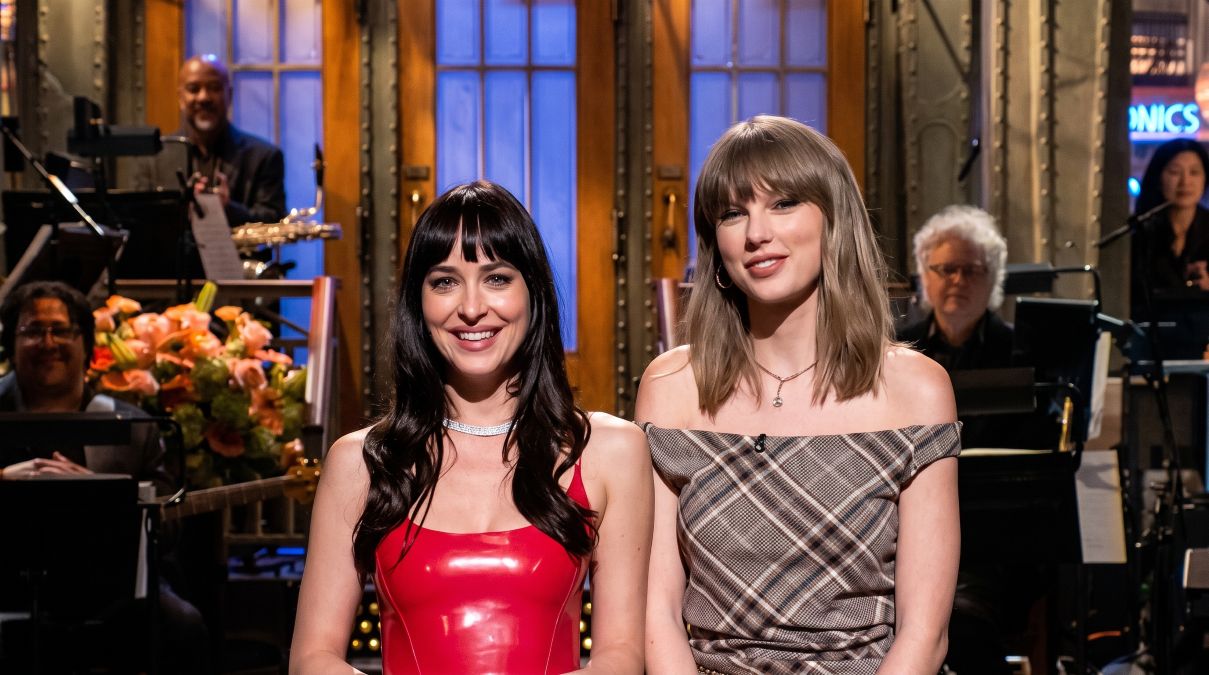
Dakota Johnson was the host. Turnstile was the musical guest. But Taylor Swift needed only a surprise appearance and a few jokes to hijack the conversation around “Saturday Night Live.”
That is not an insult to Johnson. It is a measure of what happens when Swift enters a room — even a room designed to make somebody else the center of attention.
During Johnson’s opening monologue, the actress joked about her dating history before introducing Swift as her “literal therapist.” Swift appeared and undercut the premise, describing a friendship ritual that sounded less like therapy and more like a weekly oversharing session. The bit moved into jokes about musicians, Johnson’s breakups and a Cleveland reference connected to Swift’s husband, Travis Kelce.
By the end of the episode, Swift was back with a birthday cake for Johnson.
The cameo was brief. The reaction was not.
A celebrity appearance is now an entire content cycle
Variety reported that fans had been anticipating a Swift appearance because Johnson recently starred in Swift’s “Patient Zero” music video. That connection gave the cameo a built-in audience before NBC even aired it.
What followed is the modern celebrity machine working exactly as designed.
A television appearance becomes clips. The clips become fan analysis. The analysis becomes screenshots, memes and headlines. Small details are treated like clues. Clothing, phrasing, facial expressions and references are dissected for meaning.
For most celebrities, a cameo is promotion. For Swift, a cameo can become a parallel event running alongside the show itself.
That is partly because her audience has been trained to look for layers. Swift has spent years using symbols, callbacks and carefully timed hints in her music and promotion. Fans learned that paying close attention can be rewarded.
Now almost anything she does can trigger the same behavior, whether or not every detail was meant to carry hidden meaning.
The friendship was part of the product
The funniest part of the sketch may have been the way it converted a real friendship into public entertainment.
Johnson’s dating life was fair game because Johnson made it part of the joke. Swift’s role worked because audiences already understand the celebrity-friendship ecosystem around her. The bit was not asking viewers to believe Swift is literally Johnson’s therapist. It was inviting them into an exaggerated version of private intimacy.
That creates a strange dynamic.
Celebrity culture once depended on distance. Stars were interesting because the public knew relatively little about them. Modern celebrity depends on managed closeness. Fans see group dinners, birthday messages, backstage photos, podcast confessions and social-media interactions. Friendship becomes part of the public narrative.
That does not mean the friendships are fake. It means real relationships can still function as entertainment once cameras are involved.
Even the smallest Swift moment becomes bigger than itself
Swift has not needed to host “SNL” regularly to remain part of its mythology. Her past appearances, musical performances and cameos are catalogued like chapters. That means a few minutes beside Johnson can immediately be placed into a much larger fan timeline.
The same thing happens when she appears at a football game, an awards show or somebody else’s concert. The question quickly stops being only what happened. It becomes what it means, what it references and what might happen next.
For “SNL,” that is an obvious advantage. Surprise creates conversation, and conversation keeps an episode alive well after broadcast.
For Johnson, the cameo also worked because she did not disappear inside it. She used Swift’s presence to extend jokes about her own public image, relationships and new film.
Still, the imbalance is impossible to miss: Swift can walk into someone else’s monologue and become the internet’s headline.
That is celebrity power in its most concentrated form. Not simply the ability to draw attention, but the ability to reorganize attention around yourself without appearing to demand it.
Johnson got her birthday cake. “SNL” got its viral moment. Swift’s fans got another scene to analyze.
And the rest of the internet got exactly what it seems to want from celebrity culture now: a private friendship, turned public just long enough for everybody to have an opinion about it.
The episode also showed how television increasingly competes for attention after the broadcast rather than only during it. The sketch had to work in Studio 8H, but it also had to survive as a 30-second clip on phones the next morning. Swift is almost perfectly built for that second life.

Comments