
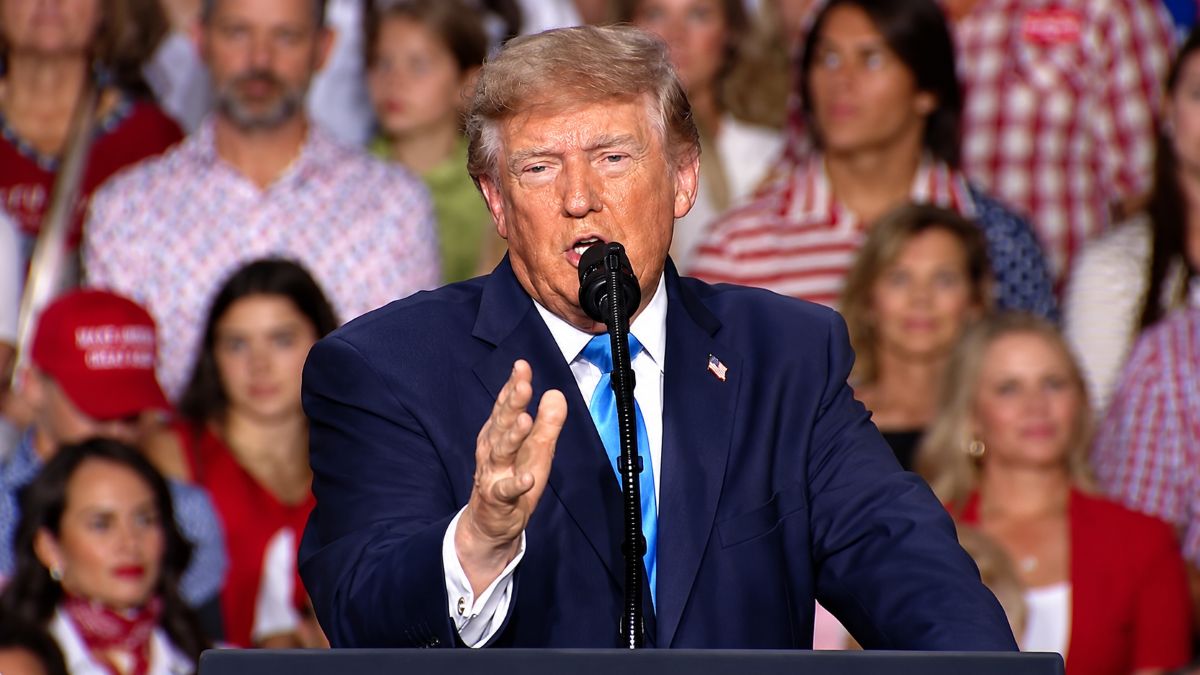
Nebraska is not supposed to be the place where a Republican president has to spend precious time reassuring his party a month before the midterm elections.
Yet President Donald Trump traveled to Grand Island on Monday to campaign for Republican Sen. Pete Ricketts, who is facing independent challenger Dan Osborn in a race that has become competitive enough to command presidential attention.
That alone is the story.
A campaign stop in a deep-red state does not automatically mean Republicans are about to lose it. Ricketts remains a formidable incumbent, Nebraska has long leaned Republican, and presidential visits can be used to boost turnout rather than rescue a doomed candidate. But campaigns are ruthless about time. When the calendar gets short, where a president goes says something about what his party is watching.
And Republicans are watching Nebraska.
The economy is making safe territory less comfortable
Reuters reported that Trump’s trip was aimed at rallying Republicans while promoting his economic agenda. The Associated Press described Nebraska as part of a wider pre-midterm blitz as voters continue to complain about high prices, including fuel and groceries.
That creates an awkward split between the administration’s message and the mood of many voters.
Trump has described the country in triumphant economic terms. But voters do not experience the economy through presidential language. They experience it when they fill a diesel tank, buy groceries, renew insurance or look at the interest rate attached to a major purchase.
That disconnect is especially important in rural states, where fuel prices, agricultural costs and commodity markets can land differently than they do in a big coastal city.
Ricketts is not running in isolation from that frustration. Osborn, a labor-oriented independent who previously ran a surprisingly competitive Senate campaign, offers voters an option that does not carry the Democratic label but can still channel anti-establishment anger.
That is a tricky opponent in a state where the Republican brand is strong.
Trump wants voters to see him on the ballot
At the rally, Trump urged supporters to treat the midterms as though he personally were running. That strategy makes sense for Republicans because Trump remains the party’s most powerful turnout engine.
It also comes with risk.
If the election becomes a referendum on Trump, then dissatisfaction with prices, foreign policy or Washington can become dissatisfaction with Republican candidates who otherwise might prefer to localize their races.
The Nebraska stop therefore carries two messages at once. Republicans are betting Trump can energize voters who might otherwise stay home. Their decision to deploy him there also suggests the party is unwilling to assume those voters will show up automatically.
That is not panic. It is evidence of a more complicated map.
Why Nebraska matters beyond one Senate race
Political parties get into trouble when they confuse a state’s recent voting history with permanent ownership.
Nebraska may still vote Republican comfortably at the top of the ticket. But an independent candidate can scramble normal partisan expectations, especially when voters are frustrated with both parties. A race does not need to become a toss-up to force a campaign to spend money, presidential time and organizational energy that could have gone somewhere else.
That is the hidden cost of a defensive race.
The bigger warning for Republicans is not that Nebraska has suddenly turned blue. It is that economic frustration can create openings in places where party strategists normally expect the brand to do most of the work.
For Democrats, there is a different complication. Osborn is independent, and his appeal depends partly on not looking like a conventional Democratic candidate. National Democrats may like the possibility of weakening Republicans, but too much visible embrace can undercut the very identity making the race interesting.
So Nebraska has become an unusually clean test of voter mood. Can Trump still turn a red state into a turnout machine simply by arriving? Can Ricketts make the race about Republican loyalty? Can Osborn turn frustration into a coalition without being swallowed by national party politics?
The answer may matter far beyond Nebraska. When a party has to fight harder for ground it once treated as automatic, the rest of the map starts looking different too.
There is another reason strategists care: Senate control can turn on a handful of races, so forcing Republicans to defend a state they usually take for granted has value even if the challenger ultimately falls short. Time, money and presidential attention spent in Nebraska cannot be spent twice.

Comments